
0
Custom Cast Urethane Parts
Custom Cast Urethane Parts & Application Solutions
From Urethane Stock Shapes to Fully Molded Components
When engineers and maintenance managers search for urethane sheet, rod, or bar stock, they often assume the next step is machining the material themselves. While polyurethane stock is ideal for fabrication, many applications benefit from something more precise: custom molded urethane parts produced in a steel die built specifically for your component.
At Universal Urethane, we supply cast polyurethane stock in sheet, rod/round, bar/square, and block formats, but we also design and build steel dies that allow us to pour liquid urethane into the exact geometry your application requires. The result is a finished, production-ready component with repeatable dimensions, consistent hardness, and reduced waste.
If you need more than raw stock, we can manufacture your urethane part to match your drawing, sample, or performance requirements.
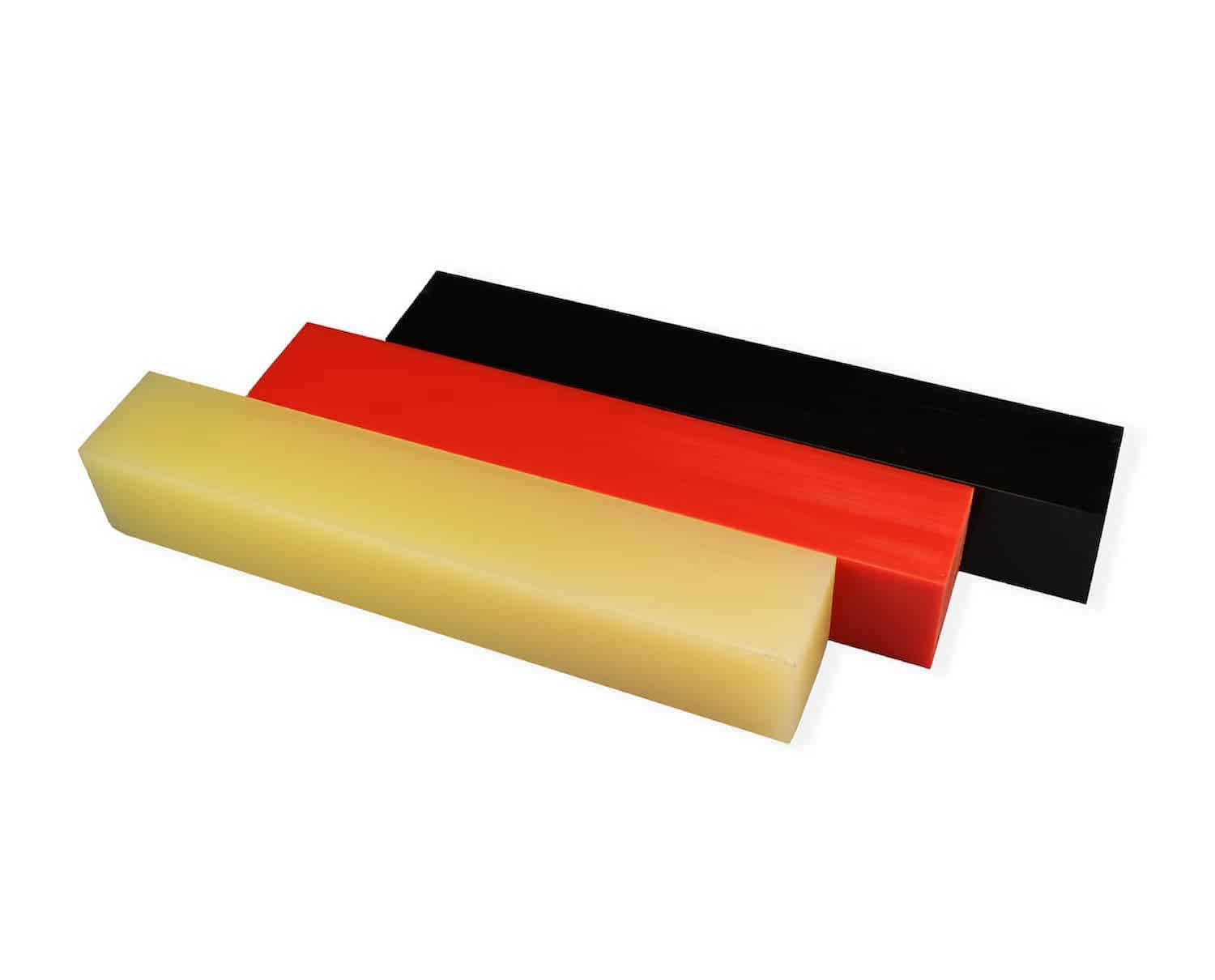
You Don’t Have to Machine It Yourself
A common misconception in industrial purchasing is that buying urethane stock means committing to in-house machining, for low volumes or prototyping. But for repeat parts, higher quantities, or complex shapes, custom molding is often more efficient and more economical.
By building a precision steel die, we can:
- Eliminate internal machining labor
- Reduce scrap material
- Improve dimensional repeatability
- Produce complex geometries that are difficult to machine
- Maintain consistent Shore A hardness throughout the part
- Lower long-term per-part costs for production runs
Instead of starting with a urethane rod and turning it into a bushing, or cutting sheet into wear pads, we can mold the exact finished component ready for installation.
How Custom Urethane Die Molding Works
Custom cast polyurethane molding is a controlled manufacturing process designed for dimensional accuracy, material consistency, and repeat production efficiency. Unlike machining from stock shapes, molding forms the part in its final geometry during the casting stage, minimizing waste and secondary operations. This approach is especially valuable for components with complex profiles, internal features, or repeat order quantities.
Because the material is poured in liquid form and cures inside a precision steel die, the finished component achieves uniform hardness, structural integrity, and surface finish throughout. This method allows for tighter tolerances and better consistency across production runs, making it ideal for engineered industrial components where performance and repeatability are critical.
1. Drawing or Sample Review
We begin by reviewing your CAD files, prints, or physical sample. If reverse engineering is required, we measure geometry and test hardness to match performance characteristics.
2. Tooling & Die Design
A steel die is designed to form the exact shape required. This die becomes the mold cavity for production runs.
3. Die Fabrication
The die is precision-machined from steel to withstand repeated casting cycles.
4. Liquid Urethane Pour
Liquid polyurethane is mixed and poured into the die cavity. Material formulation and Shore A hardness are selected based on your application, commonly ranging from 60A to 95A.
5. Cure & Demold
The material cures within the die, achieving full strength and dimensional stability before removal.
6. Finishing & Inspection
If required, minor secondary finishing operations are performed. Each part is inspected for dimensional accuracy and surface quality.
7. Production Runs
Once tooling is complete, repeat production runs are efficient and consistent.
This process produces cast urethane components with superior abrasion resistance, flexibility, load-bearing capacity, and chemical resistance compared to many rubber alternatives.
Common Custom Urethane Applications
Polyurethane is one of the most versatile engineered elastomers used in industrial environments today. Its ability to combine flexibility, strength, and abrasion resistance makes it suitable for both dynamic and static applications across multiple industries. From high-impact material handling systems to vibration-dampening machine components, molded urethane parts are often selected when rubber wears too quickly or metal causes surface damage.
Because urethane formulations can be adjusted for hardness, resilience, and environmental resistance, each application can be tailored to match load requirements, temperature exposure, chemical contact, and wear conditions. This adaptability is why cast urethane components are found in everything from conveyor systems to heavy equipment and precision manufacturing lines.
Material Handling & Conveyor Systems
In conveying environments, components must withstand continuous abrasion, impact, and load cycling. Molded urethane offers superior wear resistance while protecting mating surfaces from damage.
Typical applications include:
- Conveyor wear strips
- Guide rails
- Custom rollers
- Impact pads
- Belt skirting
- Chain guides
- Scraper blades
Hardnesses in the 85A–95A range are common for high-wear zones. Compared to steel, urethane reduces noise and prevents belt damage. Compared to UHMW, urethane provides improved load-bearing and resilience under impact.
Industrial Machinery & Equipment
Machinery components often require both durability and flexibility. Molded urethane absorbs shock and vibration while maintaining structural integrity.
Applications include:
- Bushings and sleeves
- Vibration dampeners
- Press pads
- Mechanical stops
- Bumpers
- Shock absorbers
- Seals and gaskets
For dynamic loading conditions, selecting the correct durometer is critical. Softer formulations provide energy absorption, while higher durometer materials provide structural support and wear resistance.
Heavy Equipment & Agriculture
In agricultural and heavy equipment applications, urethane must perform in extreme temperatures and abrasive environments.
Common parts include:
- Scraper blades
- Wear liners
- Auger encapsulations
- Plow edges
- Debris deflectors
- Protective bumpers
Urethane maintains flexibility in cold weather conditions where rubber can stiffen or crack. Its abrasion resistance significantly extends service life in soil, aggregate, and high-impact applications.
Manufacturing & Processing Environments
Manufacturing facilities demand components that perform reliably under continuous operation, mechanical stress, and repetitive impact. Downtime caused by worn or failed parts directly impacts production output and maintenance costs. Molded urethane components are often selected to extend service intervals while protecting surrounding equipment from damage.
In processing environments where precision and consistency are essential, custom molded parts help maintain alignment, reduce vibration, and improve overall system stability. Whether used in automated equipment, packaging lines, or assembly systems, cast urethane components contribute to smoother operation and longer equipment life.
Applications include:
- Custom rollers
- Processing pads
- Impact blocks
- Machine guards
- Protective linings
- OEM replacement parts
If your production line currently uses rubber or metal parts that wear prematurely or damage mating surfaces, molded urethane can improve service intervals and reduce downtime.
OEM Replacement & Reverse Engineering
Many manufacturers face challenges when OEM parts become unavailable or obsolete. Universal Urethane can reverse engineer urethane components based on a sample part.
We can:
- Measure geometry
- Match Shore A hardness
- Replicate color if required
- Build a production die
- Produce repeatable runs
This is especially valuable for older equipment where replacement components are no longer readily available.
From Stock Shapes to Finished Components
Urethane sheet, rod, bar, and block stock provide flexibility for fabrication shops and maintenance departments that prefer to machine parts in-house. However, machining polyurethane from stock shapes can introduce variability in tolerances, increase scrap rates, and add significant labor time, especially for repeat components or higher production volumes. Each cut, turn, or milled profile requires equipment setup, operator time, and post-processing inspection.
When dimensional consistency, surface finish control, and repeatability are critical, molding the component to its final geometry often produces superior results. Instead of removing material to create the shape you need, the part is formed directly in a precision steel die. This eliminates unnecessary waste, reduces machining hours, and improves long-term production efficiency.
For applications that require identical replacement parts over time, such as bushings, wear pads, rollers, or guide rails, custom molded urethane ensures every unit matches the original design. This approach shifts production from a fabrication-based process to a controlled manufacturing process, delivering consistent quality with predictable lead times and cost structure.
|
Starting with Stock |
Required In-House Work |
With Custom Molding |
|
Urethane Rod |
Turn & machine bushings |
Receive finished bushings |
|
Urethane Sheet |
Cut & profile pads |
Receive pre-formed pads |
|
Urethane Bar |
Mill complex profiles |
Receive molded guide rails |
|
Block/Drops |
Custom shaping required |
Receive finished wear components |
For single prototypes or one-off applications, stock material may be appropriate. For repeat parts, molding reduces labor and variability.
When Does Custom Die Tooling Make Financial Sense?
While purchasing urethane stock and machining parts internally may appear cost-effective initially, long-term production needs often justify investment in custom tooling. As order quantities increase or part complexity grows, the labor and material waste associated with machining can exceed the upfront cost of die fabrication.
Custom die molding becomes financially advantageous when repeatability, reduced scrap, and lower per-unit production costs are priorities. Over time, molded components typically offer greater cost efficiency, especially in medium-to-high volume production runs where consistency and turnaround time are essential.
- Parts are ordered repeatedly
- Machining scrap rates are high
- Labor costs are significant
- Dimensional repeatability is critical
- Complex geometries are required
While there is upfront tooling cost, the per-part cost decreases significantly over time. For medium-to-high production volumes, molding is typically more economical than machining from stock.
Material Options & Performance Characteristics
Selecting the correct polyurethane formulation is critical to achieving optimal performance in industrial applications. Hardness, resilience, chemical resistance, and load-bearing requirements must all be evaluated before determining the appropriate compound. Unlike generic elastomers, cast polyurethane can be engineered to meet specific performance demands.
By adjusting formulation and Shore A hardness, components can be optimized for abrasion resistance, impact absorption, flexibility, or structural support. This flexibility in material design is one of the key reasons polyurethane outperforms traditional rubber and many plastics in demanding industrial environments.
Hardness Range
- 60A Shore A (high flexibility, impact absorption)
- 70A–80A (balanced flexibility & durability)
- 85A–95A (high abrasion resistance & load support)
Performance Characteristics
- Excellent abrasion resistance
- High tear strength
- Strong load-bearing capacity
- Chemical and oil resistance
- Reduced noise compared to metal components
- Surface protection for mating materials
Color options are available depending on formulation and application requirements.
Why Choose Cast Urethane Over Rubber or Metal?
Material selection directly affects durability, maintenance frequency, and system performance. While rubber and metal have historically been used in many industrial components, cast polyurethane offers a balance of strength and elasticity that neither material provides on its own. It can withstand impact while resisting abrasion, and it protects mating surfaces rather than damaging them.
In applications where noise reduction, surface protection, and extended service life are priorities, urethane frequently delivers superior results. Its ability to absorb shock, resist tearing, and maintain structural integrity under load makes it a preferred material for engineers seeking long-term reliability.
Compared to rubber:
- Longer wear life
- Higher load capacity
- Greater abrasion resistance
Compared to metal:
- Noise reduction
- Surface protection
- Corrosion resistance
- Reduced weight
Compared to plastic:
- Superior impact resilience
- Greater flexibility without cracking
This combination of strength and elasticity makes polyurethane one of the most versatile industrial materials available.
Frequently Asked Questions
Can polyurethane be molded into custom shapes?
Yes. Liquid polyurethane is poured into a steel die that forms the exact geometry required. This allows repeatable production of complex shapes.
What is a urethane die?
A urethane die is a precision-machined steel mold used to shape liquid polyurethane during the casting process.
Is cast polyurethane stronger than rubber?
In many industrial applications, cast polyurethane offers higher abrasion resistance, greater load capacity, and longer service life than standard rubber compounds.
What industries use molded urethane parts?
Material handling, manufacturing, agriculture, heavy equipment, processing plants, and OEM machinery applications all use cast urethane components.
What is the minimum order for custom urethane parts?
Minimums vary based on tooling requirements and part complexity. Production runs are most cost-effective for repeat components.
Can you reverse engineer a urethane part?
Yes. We can evaluate a physical sample to match hardness and geometry before building production tooling.
How long does it take to build a die?
Lead times depend on part complexity and tooling scope. Our team can provide estimated timelines during the quoting process.
Request a Custom Urethane Part Quote
Whether you need raw urethane stock for fabrication or a fully molded production component, Universal Urethane provides engineered solutions designed for industrial performance.
If you have a drawing, CAD file, or sample part:
- Upload your print
- Submit dimensional requirements
- Specify hardness range
- Describe operating environment
Our team will review your application and provide a detailed quote, including tooling considerations, production lead time, and material recommendations.
request a quote
Need Raw Stock Instead?
We continue to supply:
If you’re unsure whether machining or molding is right for your application, contact us. We’ll help determine the most efficient and cost-effective solution for your requirements.
Shop Urethane stock